Written by PEL Lab Leader Shiho Fuyuki
In Seattle, the communities that create a neighborhood’s culture are often the first to be priced out of the neighborhood, unless they own the land and buildings that make up the neighborhood. But how do communities get there?
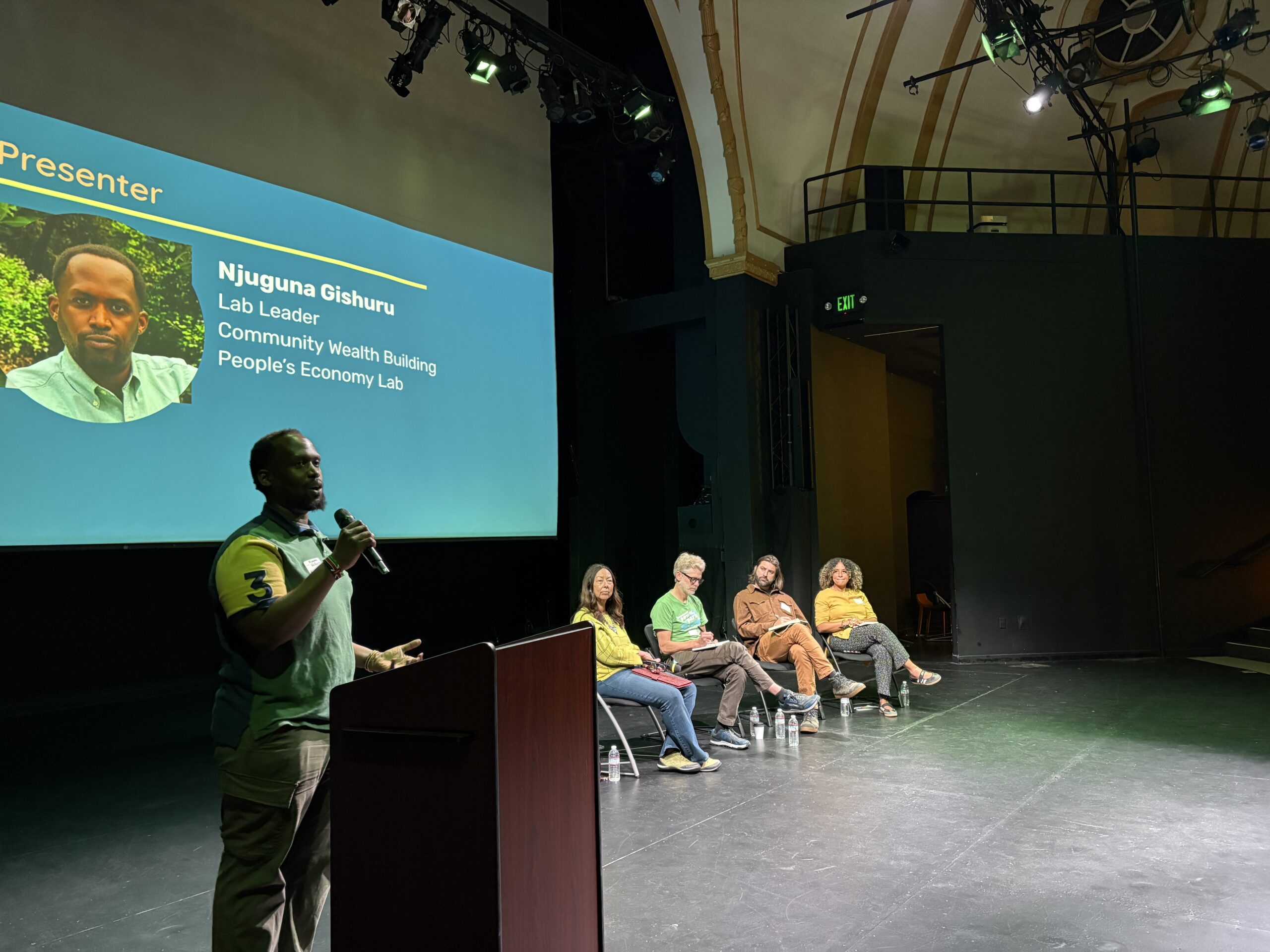
At our October session on community ownership models, presented as part of 4Culture and the Seattle Equitable Development Initiative (EDI)’s Community of Practice Gathering, we invited four practitioners with firsthand experience to share what they’ve learned, hard parts included, for anyone thinking about taking this path.
Community ownership
Lab Leader Njuguna Gishuru started us off with a simple definition: community ownership puts land, buildings, and enterprises in the hands of the people who use them, with shared control and benefits that last.
Njuguna was quick to point out that none of this is new. Indigenous peoples, including the Coast Salish peoples whose land we met on, held land as a relationship and a responsibility long before private property came into the picture. Weavers in Rochdale, England wrote the cooperative principles many co-ops still follow in 1844, and Black communities, who were shut out of markets and credit, built their own co-ops and mutual aid societies. The first community land trust, New Communities, was founded in Albany, Georgia in 1969.
Seattle now has community ownership infrastructure of its own in the Equitable Development Initiative (est. 2016) and Cultural Space Agency (est. 2021).
The four aspects key to designing and evaluating community ownership models are shared ownership, democratic control, community benefit, and permanence.
A spectrum of models
The right structure for community ownership depends on a lot of things: your purpose, how ready you are for shared governance, your organization’s capacity, the capital you can access, tax and securities requirements, the property itself, and your partners. Many projects combine structures or change them over time.
Here are a few of the models:
| Approach | How control and benefit work | Key constraints |
|---|---|---|
| Protected lease | Longer tenure, negotiated rent limits or purchase rights. The landlord keeps the title. | No equity, and your rights can end when the lease does. |
| Partner-held acquisition | A trusted public or mission-aligned entity buys the property first, with a documented path to transfer it. | The transfer price, timeline, and conditions need to be spelled out. |
| Nonprofit ownership | A 501(c)(3) or other nonprofit holds title, and its board stewards the mission and eligibility for charitable funding. | Community voice may stay indirect, and you’ll need operating reserves. |
| Nonprofit shared governance | A nonprofit holds the title, while members or users have enforceable decision-making rights. | Requires solid bylaws and governance education, and works within tax-exempt limits on distributions. |
| Community land trust | Long-term stewardship of land, often through ground leases and mission commitments. | Takes ongoing stewardship and comes with limits on use and resale. |
| Community investment | Residents invest through an appropriate legal vehicle and may earn a return. | Requires securities compliance, investor education, and sound property economics. |
| Cooperative ownership | Members collectively own or control the property and vote under cooperative rules. | Heavy governance demands, plus limits on financing and grants. |
These models can also be layered. For example, a land trust might hold the land, a nonprofit or co-op might own the building or run it, and an investor entity might put up part of the purchase price. Arrangements like that take coordinated legal, financial, and governance design. No single organizational form is a complete solution on its own.
From the practitioners
Joe Seamons, Black and Tan Hall
Black and Tan Hall began in 2016 as a small group of organizers leasing a 1919 theater in Hillman City. The name honors Seattle’s original Black and Tan Club at 12th and Jackson, along with the Jim Crow–era clubs that welcomed integrated audiences in defiance of segregation.
From the start, the group designed for low-barrier ownership. Partners put in about 52 hours of labor a year, credited toward equity, and could buy in for as little as $5 a month. Then came years of conflict with the landlord, which motivated Black and Tan’s members to explore owning their building instead of renting.
When EDI expanded its funding to include for-profit entities, Black and Tan Hall jumped to meet the opportunity. In 2020, the City funded the roughly $1 million purchase and put the deed in the group’s name. In return, a covenant requires about $2,800 a month in free and low-cost programming for 37 years. Today, the Hall is a 22-member limited cooperative association with evening programming and a Sunday brunch.
Lessons learned:
- Sign leases as your entity, never in your own name.
- Check the tax treatment early. The IRS counted members’ sweat-equity hours as income, which pushed the group to convert from an LLC to a co-op between 2021 and 2024.
- Plan for the building’s whole life, not just opening day. The group put off some work to get the doors open, and now its HVAC system is at the end of its life. Because of the covenant, the Hall can’t borrow against the building to fix it.
- Recruit members for capacity, not just passion. Running a co-op and member-owned space requires time and skills, like communications and legal expertise.
- Organize with your neighbors. Several Rainier corridor groups used shared language in their EDI proposals, and many of them were funded.
Stephanie Morales, MADE Space
Stephanie is a Seattle-born artist who started out producing her own exhibitions, then began opening space to other artists. Over and over, finding and keeping a venue ate up the budget, and holding space for Black and Brown artists made landlords suspicious. When her Central District landlord became difficult after COVID, Stephanie decided renting would never be enough.
Through the Building Art Space Equitably (BASE) program and the wider social purpose real estate field, Stephanie connected with the Kensington Corridor Trust in Philadelphia and The Guild in Atlanta. She’s now pursuing a Community Stewardship Trust, a model The Guild developed. In a Community Stewardship Trust, an LLC owns the commercial property, and local residents can buy investment shares. The Guild’s first site using this model pairs affordable apartments with ground-floor uses the community chose, including a grocery store and commercial kitchens stocked by local farmers. The Guild has offered to help MADE Space replicate the model once it acquires a site.
Lessons learned:
- Double or triple your timeline. Social purpose real estate takes far longer than anyone expects.
- Find thought partners, and be ready to pivot. MADE Space is weighing its current building against other sites.
- Practice shared ownership before you own anything. A separate live-work and food-growing pilot is giving the group a chance to test the interpersonal side of governing together.
Miles Nowlin, Northwest Community Land Trust Coalition and City of Seattle
Miles got his start with the Northwest Cooperative Development Center, knocking on doors in manufactured home parks to help residents form co-ops and buy their land before investors or redevelopers could. He later helped build the membership structure of the Common Ground Housing Trust in Walla Walla, and helped secure its first parcel through a partnership with a private developer, the City, and the Washington State Housing Finance Commission. That project is now breaking ground, three to four years in.
Today, Miles supports Reconnect South Park for the City of Seattle and serves on the board of the Northwest Community Land Trust Coalition, which spans six states.
Lessons Learned:
- Scale is a challenge. At the current pace, new land trusts can’t keep up with the need for affordable housing and anti-displacement work.
- Democratic control has to be real. Not every CLT has a membership base, and where one exists, it can sometimes be treated as symbolic.
- CLTs are tools for social movements. He pointed to the Caño Martín Peña Community Land Trust in Puerto Rico, which also organizes around environmental stewardship, and urged the field to think beyond permanently affordable homeownership.
Cheryl Markham, People’s Community Law
Cheryl spent years in legal aid and at King County, where she helped create Communities of Opportunity. She founded People’s Community Law to meet growing demand for cooperative legal support. Washington, she told us, gives groups more flexible options than most states do:
- LLCs can operate cooperatively and are very flexible. They can’t use “cooperative” in their name, though, and they offer less structure and protection.
- Cooperative corporations allow multiple classes of members and non-voting preferred investors, and come with board requirements.
- Limited cooperative associations let investor-members participate while core members always keep the majority vote. This is the structure Black and Tan Hall chose.
- Nonprofits come in two varieties: Tax-exempt charities can’t distribute surplus. Non-exempt nonprofits can, which is why housing co-ops and resident-owned communities use them.
A few lessons from Cheryl:
- Co-ops aren’t exempt from securities law. Only a pure worker-owned co-op is. Most other offerings need at least a state filing and a federal exemption.
- Talk to a lawyer before you file. Choosing the wrong statute is expensive to undo, and Washington only allows some direct conversions. Consultations with lawyers are often free or low cost.
- Co-ops investing in co-ops can build the whole ecosystem. Institutions like Shared Capital Cooperative let cooperatives pool their capital to fund one another.
What our region needs next
One thing became apparent as we listened to each of the practitioners sharing about the projects they’ve worked on. Buying the building is a milestone, not the finish line. Renovation, staffing, governance, member participation, earned revenue, and legal support are what decide whether ownership actually serves the community it was meant for.
Right now, too many projects have to figure all of this out from scratch. Making the path easier for the next group depends on what we build together. That means early, accessible legal and technical help. It means peer learning that captures templates and lessons from projects already underway. It means patient capital designed for co-ops and community investment. And it means supportive policy, like EDI’s funding for community-owned for-profits.
It was a privilege to curate and facilitate this session. Thank you to Njuguna, Joe, Stephanie, Miles, and Cheryl for sharing so generously, and to EDI and 4Culture for hosting!