In 2026, People’s Economy Lab turns 10! We’re marking our anniversary by catching up with some of the original founders of and participants in People’s Economy Lab.
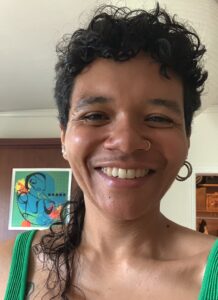
Our fourth interview is with Monica Marie Avery, Finance Admin and Teacher Team at CompassPoint.
Read our first interview with Shevanthi Daniel here. And our second interview with Christine Hanna here. And our third interview with Ryan Quigtar here.
Q: What were you doing 10 years ago in 2016?
A: At that time, I was working for Got Green, a social justice organization working at the intersection of environmental and racial justice. I was the program director for the Young Leaders in the Green Movement campaign, which supported the creation of living-wage, green job internships for BIPOC young adults. Similar to the People’s Economy Lab, there was an economic development focus.
Q: What motivated you to get involved with People’s Economy Lab when it was first getting started?
A: The executive director of Got Green at the time, Jill Mangaliman, had been invited to join the Lab. They reached out to me and asked if I wanted to join too, because they knew this was a topic I was excited about. I appreciate that folks working on alternative economics are always focused on what we’re building towards, the world we want to create, what we’re saying “yes” to, rather than what we’re saying “no” to.
Moving resources is such a big part of how the world works. For example, people working on alternative economics might ask the question, “if we didn’t use money, how would we interact with each other, how would we move resources?” Those kinds of questions have always been of interest to me, and I saw that in the Lab.
Q: What are you doing now?
A: I knew that I was going to leave Got Green when I hit the top age range of our program, which was 35 years old. And after I left Seattle, I knew that I wanted to get an MBA. So I went to Bard College, and I got an MBA in sustainability. I always say that program was a mix of compassionate capitalists and anti-capitalists.
At Bard, I realized I was really interested in finance. There are a lot of systems set up to keep people away from understanding finance. But Bard’s investing course didn’t just educate us about traditional investments. It also included alternative forms of investing, like local investing, which was really appealing to me. Since then, I’ve put the majority of my retirement funds into local investments, and I’ve led courses on investing locally.
After Bard, I started working in nonprofit finance administration, as well as facilitating workshops in finance fundamentals and collaborative budgeting. I also serve as the organizational and finance advisor for Young Black Femmes and am board treasurer for GRAVITY, in the Bay Area.
Q: From your perspective, how has the movement for an economy that serves people and the planet changed over the last ten years?
A: My MBA program had a whole section on local investment, so that’s something of note. And there is now a movement focused on community investment funds and local investing.
There is still a very large gap with everyday people knowing how they can put their money into community investments. The focus has mostly been on how institutional investors can move their money into community investments. But everyday people are hungry for knowing how to get more involved and invest locally.
I know I’m talking mostly about finance, but that’s where my focus is now.
Q: What are your dreams or hopes for the next ten years?
A: I’m an unaccredited investor, and one of the things I really want to see, what I try to do outside of work, is grow that base. And show that that base can be really powerful for local economic growth.
I was watching a webinar one time where someone in the audience, an investor, came off mute and asked, “what are you doing to engage unaccredited investors?” It was the first time I’ve heard somebody ask that question, and I was glad to hear it.
In my generation, recycling became a big thing because they taught us it in school, and it changed us culturally. What are ways we can do that with local investing? What are ways we can reach out now to everyday people, not just rich people, to engage them in local economic development and make it as ubiquitous as the stock market? We’re already supporting local economic growth by frequenting local businesses. How else are we moving local investment forward? Everyday people can be a really powerful leverage point.
Q: Is there anything else you want to tell the People’s Economy Lab Network?
A: I’m so glad the Lab is still around. With so many things being torn down, it is good to see some things are continuing and developing.
Happy anniversary! I’m so glad I got to be part of the inaugural cohort.
Want to read more about Monica Marie? Check out this Leader Spotlight we shared in 2018.


